 Steel
Renting Hashrate vs Buying ASICs: A Break-Even Comparison
Renting hashrate wins when the rental price per terahash per day sits below what that terahash earns. At today's difficulty of 132.76 T, a 200 TH/s contract earns about $7.60 of gross BTC per day — $7.29 after the listed 4% fee on the PPS-settled block-reward component. Divide that by 200 and the break-even rental rate is roughly $0.036 per TH/s per day.
Key takeaways
- A 200 TH/s position is worth $7.29/day net of the listed 4% PPS+ block-reward fee at 132.76 T, so any rental quote above $0.036 per TH/s per day is a losing trade before electricity is even discussed.
- Owning shifts the risk to efficiency: the same 200 TH/s draws 4 kW at 20 J/TH (96 kWh, $5.76/day) but 6 kW at 30 J/TH (144 kWh, $8.64/day) — more than the position earns.
- Renting replaces capital risk with counterparty risk, so contract length, uptime terms and where the hashrate is physically hosted matter as much as the headline price.
- Neither route changes the ceiling: your share of network hashrate sets expected income, and the network produces 450 BTC a day against roughly 1,003 EH/s.
The short answer
Buy hardware if you can source machines at a price whose daily output repays them faster than they lose value, and if your power is cheap enough to keep them running through a difficulty increase. Rent hashrate if you want the same daily revenue without holding a depreciating asset, and if the quoted rate is comfortably below the network's own revenue per terahash.
That second condition is measurable to the cent, and it is the part most comparisons skip. Revenue per terahash per day is not a property of a seller; it falls out of network difficulty, the block subsidy and the coin price. On 21 September 2026, with difficulty at 132.76 T, network hashrate near 1,003 EH/s, a 3.125 BTC subsidy and 144 blocks a day, the network distributed 450 BTC — roughly $38.1 million — across all miners.
How the mechanism works
Both routes end in the same place: your machines, or somebody else's machines billed to you, submit shares to a pool, and the pool converts those shares into payouts. What differs is who owns the box and who carries which risk.
| Item | Buying ASICs | Renting hashrate | The test you can run |
|---|---|---|---|
| Upfront capital | Full hardware cost, plus racks, PSUs and spares | Usually none, or a small deposit | Revenue per TH/s per day × contract days versus machine cost |
| Power exposure | Yours: kWh × your tariff, priced by your machine's J/TH | The seller's, bundled into the rate | Is the quoted rate below $0.036 per TH/s per day at 132.76 T? |
| Efficiency risk | Full: an ageing rig keeps its wattage while the network adds hashrate | Low: hashrate is delivered as a spec, not as a wattage | Model the rig at 20 and 30 J/TH against today's gross |
| Residual value | Resale, minus depreciation and freight | None — the contract simply ends | Compare resale value with the discount the rental price carries |
| Counterparty risk | Vendor, warranty and firmware support only | Seller solvency, uptime terms and where the rigs sit | Read the uptime clause and the notice period before signing |
| Cash-flow shape | Large outflow today, small inflows daily | Small outflows in instalments, inflows daily | Match the payout cadence to your invoicing cycle |
On the payout side, the pool's mechanics are the same either way. PPS+ settles the block-reward component per share with a listed 4% fee and pays hourly against current difficulty, while the transaction-fee component is distributed with PPLNS logic at a listed 2%. Choosing PPLNS for the whole payout means a listed 2% fee on block rewards and transaction fees together, with distributions after six confirmations and a weight based on your share of pool hashrate over the last five difficulty rounds.[1] The distinction is worth reading twice if you rent: a rental that pays out monthly while you are billed monthly has a working-capital cost that hourly settlement does not.[2]
Where miners get it wrong
Comparing a rental rate with a hardware price. They are different units. One is dollars per terahash per day, the other is dollars per terahash of capacity with an indefinite life. Convert both to the same basis first: what does one terahash earn per day, and for how many days do you expect to hold it?
Assuming today's difficulty is tomorrow's. Difficulty adjusts with network hashrate, so a rate that looks profitable today can sit above revenue per terahash in a quarter. On the day the network data was read, the next adjustment was estimated at −2.12%, which is a reminder of how fast that line moves in both directions.
Forgetting that the machine keeps its wattage. Revenue falls when difficulty rises; power draw does not. A rig bought at 20 J/TH that has been repaired into 25 J/TH effective consumption has quietly lost a fifth of its margin, which is why an owned fleet needs efficiency measurement rather than nameplate specs: a published miner profitability ranking shows which models still clear their electricity cost at current price and difficulty, and it is worth checking before you buy a batch rather than after.
Treating uptime as a rounding error. A rented position that is offline 4% of the time has lost 4% of its revenue while the invoice still arrives in full. Check whether the contract credits downtime, and check whether the pool-side mining pool dashboard shows the delivered hashrate you paid for — that is the number you can audit, not the seller's headline.
Worked example
Run both routes on a 200 TH/s position. Gross daily revenue is 200,000 / 1,003,107,267,295 × 450 BTC, which is 0.00008972 BTC, or $7.60 at $84,692 per BTC. After the listed 4% fee on the PPS-settled block-reward component it is $7.29.
Route one, owned hardware. At 20 J/TH the rig draws 4 kW, which is 96 kWh a day: $5.76 of electricity at $0.06/kWh, leaving $1.53 a day of margin before rent, cooling or repairs. At 30 J/TH it draws 6 kW, or 144 kWh a day: $8.64 against $7.60 gross, so the position loses money while hashing correctly. Nothing about the coin, the pool or the contract explains that gap — it is joules per terahash.
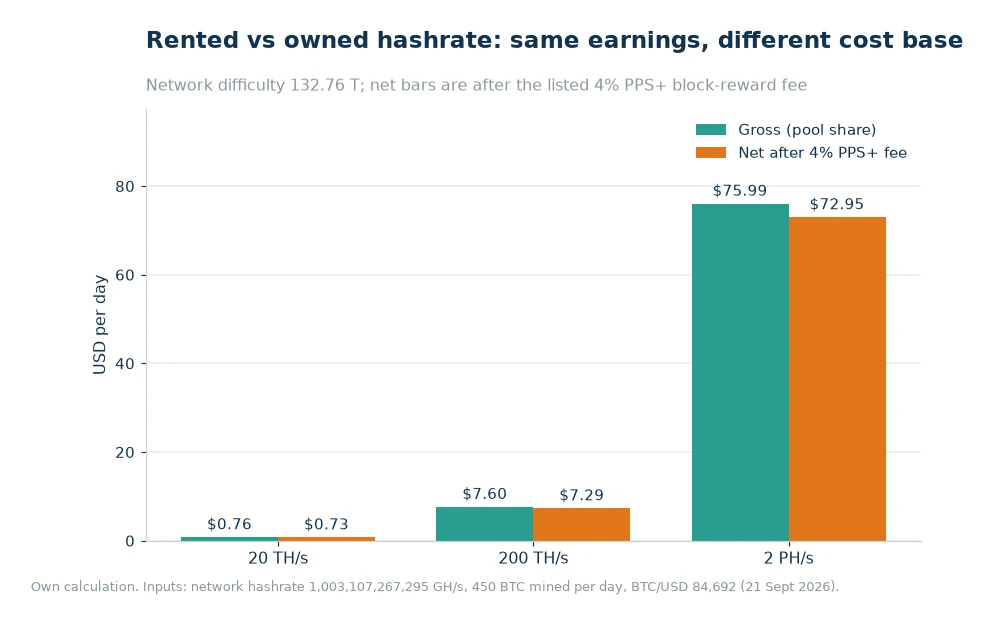
Route two, rented hashrate. The same 200 TH/s is worth $7.29 net per day, which is $0.0365 per TH/s per day. A quote of $0.030 per TH/s per day costs $6.00 a day and leaves $1.29. A quote of $0.045 costs $9.00 a day and loses $1.71 — about $51 a month on a single 200 TH/s position, with no hardware to resell at the end. At scale the units get large quickly: a 2 PH/s position earns $75.99 gross and $72.95 net per day, so the same five-thousandths-of-a-dollar error in a per-TH/s rate is worth about $10 a day.
A profit calculator collapses that arithmetic into one screen: enter the coin price, difficulty, fee rate and valid hashrate, and compare the output against the rental quote or the machine price you were given. Where the earnings land afterwards is a separate decision, and it is the one most miners make last: a multi-currency wallet inside the same account as the mining dashboard keeps deposits, withdrawals and conversion in one place instead of in three.
A checklist you can run today
- Convert everything to dollars per TH/s per day. At 132.76 T that figure is about $0.038 gross and $0.0365 net — your constant for every comparison you make today.
- Price your power twice. Once at your machine's nameplate J/TH and once at its measured consumption after a month of heat. The second number is the one that pays the bill.
- Put a difficulty path in the model. Rerun the numbers with revenue per terahash 10% and 20% lower. If only the rental contract survives that, the rental is the lower-risk position.
- Read the exit terms. For owned hardware that means resale value and freight; for a contract it means notice period, uptime credits and what happens to the rate when difficulty moves.
- Keep the pool neutral. Run both options against the same pool so the fee schedule, settlement cadence and payout thresholds do not contaminate the comparison. An account with an established ViaBTC Mining Pool gives you PPS+ or PPLNS, hourly settlement, zero-fee mining payouts and a dashboard you can audit per worker.
Frequently asked questions
Does the payout method change my average income?
It changes the variance and the fee, not the underlying expected value: your share of network hashrate still sets the ceiling.
How often should a miner check pool statistics?
Weekly is enough for cash flow, daily if you are reconciling worker uptime or chasing a hashrate fault.
Is renting hashrate ever cheaper than running your own machines?
Yes, whenever the quoted rate per TH/s per day sits below your own net revenue per TH/s per day. At 132.76 T that threshold is about $0.0365, and it moves every time difficulty adjusts.
Decide with the threshold, not the pitch
Write one number on the wall: revenue per terahash per day at current difficulty, net of the listed pool fee. Rentals are worth signing below it, and hardware is worth buying when its total cost is repaid inside the window you expect to run it. Recheck that number whenever difficulty moves, because the break-even point for both routes moves with it and neither a contract nor a machine renegotiates itself.
Data and sources: network difficulty and hashrate from public chain data, ViaBTC pricing and payment-method documentation[1] and the pool's published fee breakdown[2]. Figures use 1,003,107,267,295 GH/s of network hashrate, 450 BTC mined per day, a 3.125 BTC subsidy and a BTC price of $84,692, read on 21 September 2026. Illustrative only; earnings fall as difficulty rises.