 Steel
SteelWhat You Gain and Give Up With One Full-Service Fragrance Partner
Consolidating a men's fragrance line with one manufacturer buys coordination and costs independence. You gain a single schedule, one point of accountability and fewer handoffs between the formula, the bottle, the closure and the carton. You give up the freedom to shop each component separately and, in some cases, the lowest available price on any one of them. Whether that trade is right depends on how much of your project is development and how much is assembly.
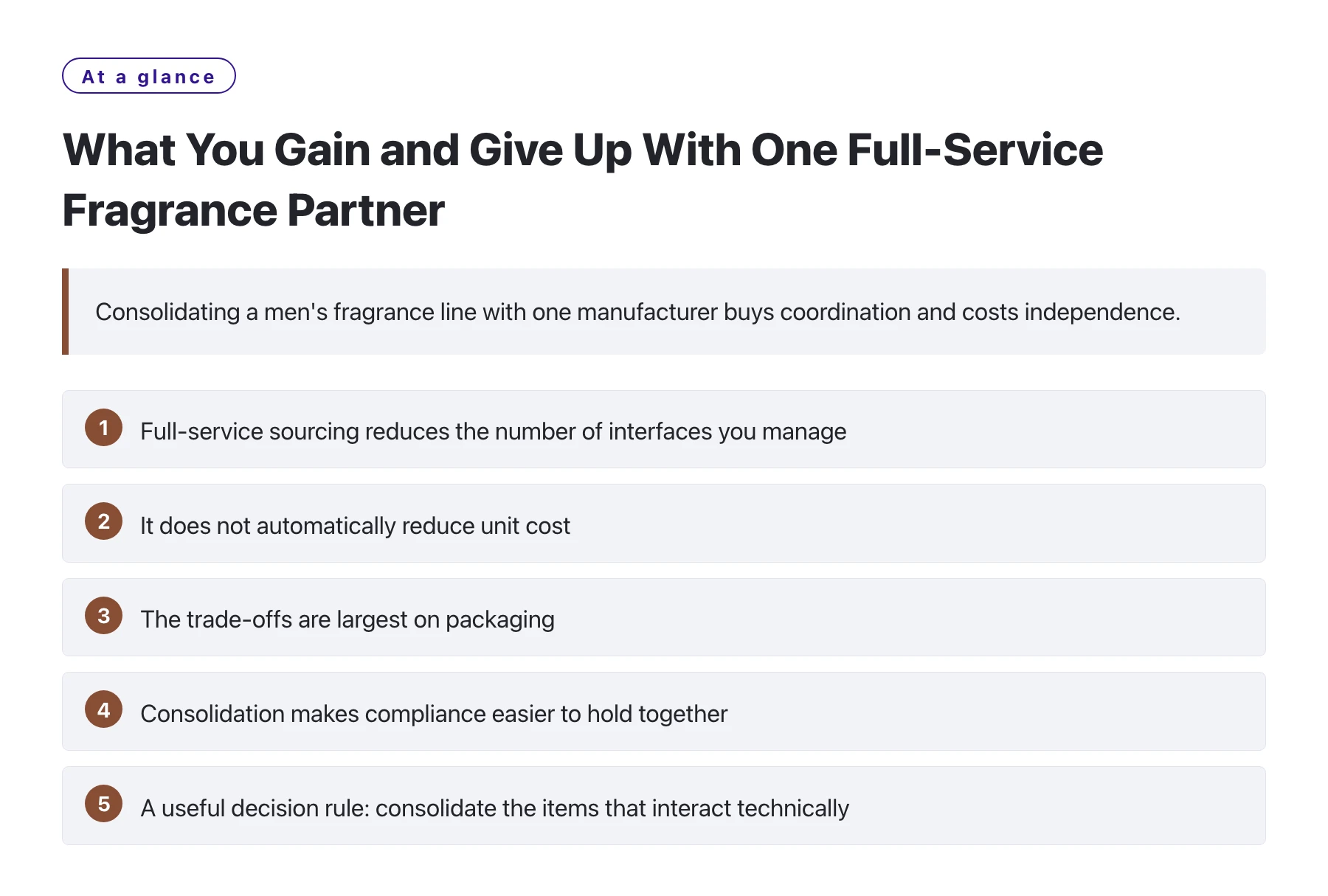
Key takeaways
- Full-service sourcing reduces the number of interfaces you manage, which is worth most when your team is small and your schedule is tight.
- It does not automatically reduce unit cost; the value shows up in coordination, accountability and fewer schedule surprises.
- The trade-offs are largest on packaging, where a single partner may have a narrower range than the open market.
- Consolidation makes compliance easier to hold together, because one party can keep the formula, material and test documents aligned.
- A useful decision rule: consolidate the items that interact technically, and keep independent the items where design is your differentiator.
The choice between one partner and several suppliers is usually presented as a cost question, and it is really a question about where your project will lose time. Every additional supplier adds a handoff, and every handoff adds a place where a delay or a defect can sit unowned.
That said, consolidation is not free. It narrows your options, concentrates risk in one relationship and can make it harder to tell whether a price is competitive, because you no longer have comparable quotes for the components inside the offer.
The table below sets out the trade-offs as pairs, so the decision can be made deliberately rather than by default.
Where consolidation genuinely pays
The strongest argument for a single partner is technical interaction. On a men's fragrance line the formula, the container, the closure and the liner all affect each other: the juice has to be compatible with the liner, the pump has to deliver the intended dose, and the glass has to survive the crimping process. When those items come from four suppliers, compatibility becomes a coordination task that nobody owns by default.
A partner that holds the whole set can test them together, and can also adjust one element to suit another without renegotiating three contracts. That is the part of consolidation that shows up as schedule reliability rather than as a line-item saving.
Accountability is the real product
With a single partner, a defect has one owner. Quality problems on a multi-supplier project are frequently traced to a handoff rather than to a process, and the cost of that ambiguity is measured in weeks. Buyers who have run one bad multi-supplier project tend to consolidate the next one, for this reason alone.
Documentation holds together better
Compliance documents have to agree with each other: the formula, the material specifications, the test results and the label. Keeping them aligned across several suppliers is possible but requires an owner on the brand side, and the use restrictions that apply to individual materials depend on the product category, so the review has to be repeated whenever the category changes [2]. It is also worth settling early where intellectual property sits when one partner holds the formula and the pack design, since WIPO guidance on contracts treats ownership and assignment as matters to be recorded rather than assumed [1].
The trade-off ledger
| Decision area | What one partner gives you | What you give up |
|---|---|---|
| Formula and container compatibility | One team tests the juice, liner, pump and glass together | Less freedom to change one element without renegotiating the whole offer |
| Bottle and closure choice | A pre-qualified range with known lead times and tested compatibility | Access to the wider market, including small glassworks and specialist closures |
| Carton and print | Print, dieline and pack assembly coordinated with the filling schedule | Independent choice of a carton supplier that may specialise in your finish |
| Schedule control | One committed schedule with named milestones and a single point of contact | Visibility of the individual supplier queues inside that schedule |
| Unit cost | Fewer transaction costs and consolidated freight, which can help smaller orders | The ability to benchmark each component against a competitive quote |
| Quality and compliance | Aligned documents and a single accountable party for the finished unit | Dependence on one quality system rather than several overlapping ones |
| Flexibility at scale | Simple to add volume to an established specification | Harder to move parts of the project to a cheaper supplier later without re-approval |
Notice that only one row is about price, and it is the one buyers weigh most heavily. The other six decide whether the launch actually happened on time.
Where consolidation costs more than it saves
The trade turns against you when the differentiator of your product sits in a component the partner does not specialise in. A men's line with a distinctive bespoke bottle, an unusual decoration or a structural carton may be better served by keeping that element with a specialist and consolidating everything else.
It also turns against you at the extremes of volume. Very large programmes can usually absorb the complexity of a split supply chain because they have the staff to manage it, and very small first orders may find that a partner's minimum for packaging forces an unnecessary commitment.
Consolidate what interacts, keep what differentiates
The rule that survives most projects is this: consolidate the components that interact technically and are hard to test in isolation, and keep independent the components where design is the reason a customer buys. On a men's line, that usually means the juice, liner, pump and glass travel together, while a signature bottle or an unusual carton may justify a separate specialist.
Ask what sits inside the offer
When several items are combined into one price, the useful question is which parts are produced in-house and which are sourced. A manufacturer that can explain the composition of its own offer, as a a manufacturer that supports OEM and ODM typically can, gives you enough information to judge where the value sits. It is also reasonable to compare it against a narrower arrangement such as Xuelei, where the scent and pack come from an existing range and the development burden is smaller. A partner that describes its coverage in detail — as Xuelei's fragrance factory does, including the stages that run beyond filling — is easier to place on this ledger than one that answers with a brochure.
One practical safeguard applies whichever route you choose: write down which items you consolidated, and why, in the project file. Eighteen months later, when the second order is priced and the third is being planned, that note is what lets you revisit the decision deliberately instead of repeating it by inertia. It also answers a question that will certainly be asked if costs rise — whether the consolidation was a considered choice or simply the path of least resistance at the time. Note the assumptions about volume in particular, because a partner's packaging minimums are often the quiet reason a first order has to be larger than the plan called for. Where the fragrance itself is developed in one place and the pack in another, the compatibility test between them becomes the most important single check in the project, so name the owner of that test in writing before either side starts work.
Sources
- WIPO — World Intellectual Property Organization —— The UN agency for intellectual property; resources on industrial design and patent protection relevant to product and packaging design.
- IFRA Standards Library (International Fragrance Association) —— The IFRA Standards Library lists the restrictions the fragrance industry applies to individual fragrance ingredients, based on safety assessments; it is the reference point for compliant fragrance formulation.
Frequently asked questions
Is full-service sourcing cheaper than using several suppliers?
Not necessarily on unit price. Consolidation reduces transaction and coordination costs, which helps smaller orders in particular, but a single partner may not have the cheapest component in each category. The clearer benefit is schedule reliability and a single accountable party.
Can I keep my own bottle supplier and still use a full-service partner?
Yes, and it is a common arrangement. It changes the scope in two places: compatibility testing between the formula, the liner and the closure, and responsibility for defects or breakage. Both should be assigned in writing, including who pays for a rejected batch of glass.
Does a single partner increase risk if something goes wrong?
It concentrates risk in one relationship, which is the honest downside. The mitigation is contractual and practical: named milestones, documented reference samples, and a clear failure process. A diversified supply chain spreads risk but multiplies the number of places a problem can hide.
When is a split supply chain the better choice?
When a component is your product's differentiator, when volumes are large enough to justify dedicated management, or when a specific specialist finish is not available from the main partner. In those cases the coordination cost is real but buys something the brand actually needs.
How do I compare a consolidated quote against separate quotes?
Ask for the offer broken down by component: juice, glass, closure, carton, filling and testing. Most partners will provide this. With the breakdown, the consolidated quote can be placed alongside individual market quotes, and the difference in coordination cost becomes visible rather than assumed.
// NEXT MOVE
Stop eating pages at 2 AM. Let SteelRats absorb them.
Senior platform engineers embedded in your stack — Kubernetes, Terraform, observability, incident response. Fixed monthly retainer. No juniors. No surprises.